Window Displays
Bright enough to win an argument with the sun.
A living-room TV in a shop window washes out by mid-morning and dies by August. These are 3000+ nit commercial displays, built to stay readable in direct sunlight and run all day, every day, through a Canadian winter and a July heatwave.
3000+ nits · anti-glare glass · auto-brightness · sealed enclosure
The problem with a normal TV
At noon, your promotion disappears.
Sunlight on a shop window is somewhere around 10,000 lux. A consumer TV puts out 300–500 nits. It isn't a close contest — the picture flattens to grey and the glass turns into a mirror of the street.
 Readable at noon
Where 3000 nits sits
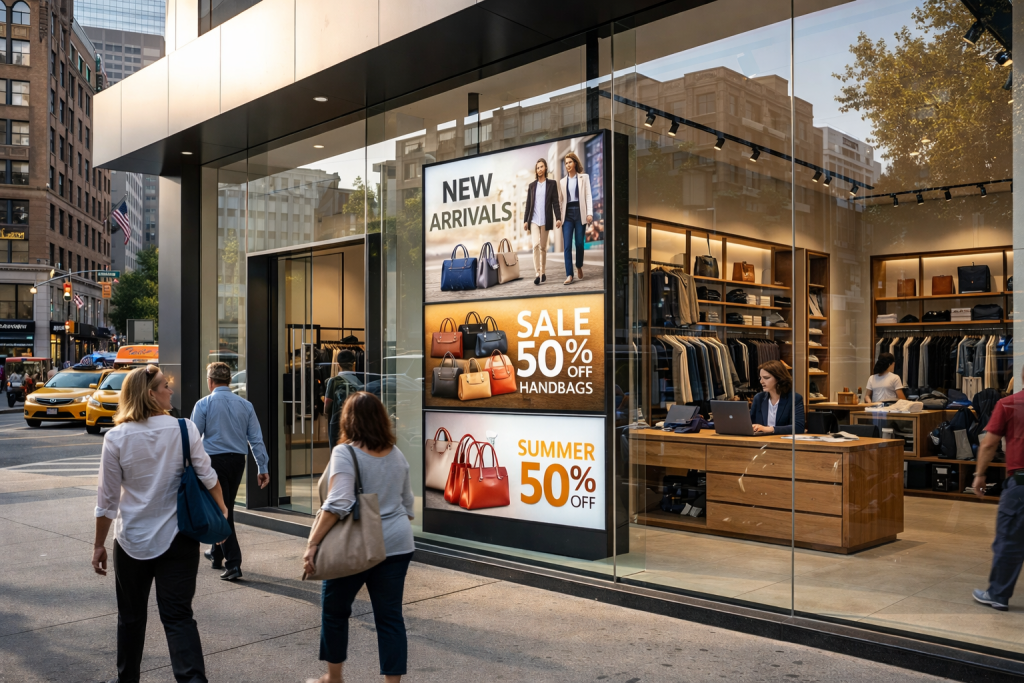
01 · Beat the sun
3000+ nits, and glass that doesn't fight you.
Brightness alone isn't enough — reflection is half the battle. These do both.
02 · Built to survive
The gap behind your window glass is a greenhouse.
That's where consumer screens die. Trapped heat causes the black blotches you've seen in other shop windows — and once that starts, the panel is finished.
Thermal management
Custom heat dissipation and automated cooling prevent the blackening failure that kills standard LCDs.
Temperature range
Built for freezing Canadian winters and baking summer heat, running 24/7 either way.
Sealed enclosure
Street dust, humidity and window condensation stay out of the electronics.
Commercial panels
Rated for continuous operation, not the two-hours-an-evening a living room TV expects.
03 · The brains behind the glass
A bright screen showing the wrong thing is just an expensive poster.
The display runs the full Retailr platform, so what's in the window reacts to the day, the weather and your stock.

04 · How it looks installed
Maximum screen. No clunky hardware.
People should be looking at your product, not at thick bezels and a trailing cable.
Ultra-thin profile
Seamless and modern, taking up as little of your window as possible.
Hidden cabling
Professional installation that looks premium from the street and from inside.
Portrait or landscape
Whichever suits the window architecture — including double-sided setups.
Ceiling or floor mount
Hung from above, on a slim floor stand, or fixed to the frame.
Where they earn their money
Anywhere the street is your best channel.
Fashion & specialty
Campaign artwork that changes with the season instead of a printed poster that fades.
Restaurants & cafés
Breakfast, lunch and dinner offers in the window, switching themselves by the clock.
Convenience & grocery
Fast-changing prices and clearance deals visible from the pavement.
Banks, clinics & agencies
Rates, services and opening information legible from outside without a poster in the glass.
Questions we get asked.
Can't I just put a normal TV in the window?
You can, and plenty do. It washes out in daylight, reflects the street, and the trapped heat behind the glass eventually causes permanent black patches. It usually costs more in replacements than the right screen costs once.
What size and orientation can I get?
Portrait and landscape in a range of sizes, including double-sided units for windows visible from both directions. We spec it to your window.
Does it dim at night?
Yes. Ambient light sensors run it at full brightness in the sun and drop it at night, which saves energy and avoids dazzling passers-by.
Who installs it?
We handle installation in most areas, including mounting and cable management. Elsewhere we'll spec it and brief your installer.
Does it need its own player?
The Retailr player drives it, either built in or as a separate box behind the display, depending on the configuration.
What happens if the internet drops?
Content is stored locally and keeps playing, then syncs when the connection returns.
Send us a photo of your window.
We'll tell you what size fits, which orientation works, how bright it needs to be for that aspect — and what it costs installed.