
How many times have you picked up a Medium that turned out baggy — or impossibly tight? Sizes differ between brands, and even between styles from the same brand. For shoppers it's frustrating. For retailers it's one of the biggest causes of returns. AI fit guidance in smart mirrors is built to take the guesswork out.
Key takeaways
- AI fit guidance compares a shopper's proportions with a garment's real measurements, not just its size label.
- It recommends a size for each style — because a "relaxed fit" M and a "slim fit" M aren't the same.
- Paired with virtual try-on, shoppers can see the fit before trying anything on.
- Done right, it's opt-in and processed on the device, with no body data stored.
Why size labels don't work
A size label is an average. It tells you roughly who the garment was cut for, not how it will sit on you. Three things make it unreliable:
Every brand grades differently
One label's Medium is another label's Large. Shoppers have no way to know without trying.
Cut changes everything
Slim, regular, relaxed and oversized fits in the same size sit completely differently.
Fabric stretches — or doesn't
Denim with elastane and rigid denim in the same size fit like different garments.
Bodies aren't averages
A longer torso or broader shoulders can make the "right" size wrong.
How AI fit guidance works
AI fit guidance matches the shopper to the garment, not to a size chart. It looks at the person's proportions, the item's actual measurements, its fabric and its intended cut — then recommends the size most likely to fit as designed.
Understand the shopper
The mirror estimates key proportions — shoulders, chest, waist, hips, inseam — using its camera and sensors, a few quick questions, or a saved fit profile.
Know the garment
It uses the item's real specs: measurements for each part, fabric stretch and drape, and the intended cut. These come from the brand's tech packs or product data.
Recommend a size
It compares the two, allowing for stretch and cut, and picks the size most likely to fit the way the designer intended.
Explain the fit
It says how the piece will sit — and flags known quirks, like a style that runs narrow in the shoulders.
Show it
With virtual try-on, the recommended size appears on the shopper's reflection so they can see the drape before changing.
What the shopper sees
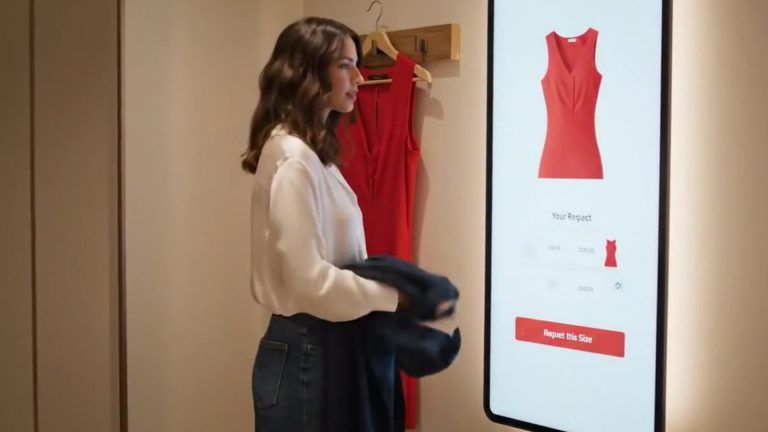
What it changes for shoppers and retailers
For shoppers
- No more guessing between two sizes or decoding a size chart
- Fewer trips back and forth to the fitting room
- Confidence to buy, because they know it will fit
- Advice that feels personal, not generic
For retailers
- Fewer fit-related returns — the most common reason clothes come back
- More sales completed when shoppers trust the size
- Better buying — see which sizes are actually needed, by store
- Design insight — spot styles that consistently fit wrong
- Less waste — fewer returns mean less shipping and less stock written off
Privacy
Fit data is personal. Treat it that way.
- Fit guidance should always be opt-in — the shopper chooses to use it
- Measurements should be processed on the device in the store, not uploaded
- Nothing is stored unless the shopper saves a fit profile themselves
- Fitting rooms themselves should never have cameras — RFID fitting rooms read the garments instead
The best size chart is the one the shopper never has to read.
Beyond the label
The single, universal size chart is on its way out. AI fit guidance lets clothing fit the individual — across body shapes, brands and cuts — and turns the fitting room from a place of trial and error into one of confidence. For retailers, it's one of the most direct ways to lift conversion and bring returns down at the same time.
Frequently asked questions
How does a smart mirror recommend a size?
It compares the shopper's proportions with the garment's actual measurements, fabric stretch and intended fit, then recommends the size most likely to fit the way the designer intended.
Does AI fit guidance need a body scan?
Some systems use cameras or depth sensors to estimate measurements; others work from a few questions or past purchases. Either way, it should be opt-in and processed on the device.
Is shopper body data stored?
It shouldn't be. Measurements should be used for the recommendation and then discarded, unless the shopper chooses to save a fit profile.
Can AI sizing reduce returns?
Poor fit is one of the most common reasons clothes are returned, so recommending the right size first time directly targets that cause.
Does it work for all clothing?
It works best for categories where fit varies most — denim, tailoring, dresses, outerwear and footwear.
See fit guidance on your own range.
Book a 15-minute demo and we'll show a smart mirror recommending sizes from your catalogue.
Keep reading

